


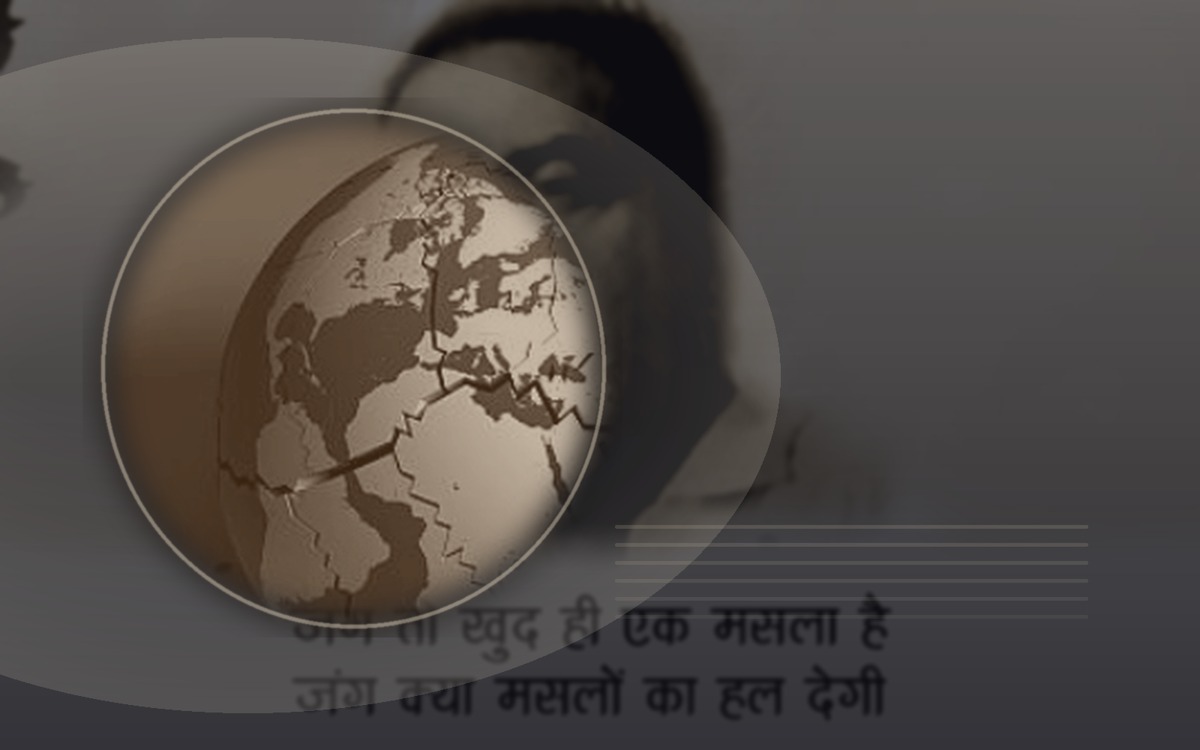
Introduction
Sahir Ludhianvi, a celebrated Urdu poet and lyricist, was known for his progressive, humanist voice. His poem “Aye Shareef Insano” is a powerful plea against war, urging humanity to reject violence and embrace compassion. It highlights the futility of bloodshed, reminding people of their shared responsibility toward peace and coexistence.

There are poems that decorate language, and there are poems that disturb the conscience. Sahir’s “Ae Shareef Insano” belongs to the second kind, because it does not ask us to admire war from a distance; it asks us to look at its human cost without the veil of slogans, flags, or patriotic noise. He sees war plainly: not as glory, not as destiny, and certainly not as a cure, but as a wound that spreads from the battlefield into the home, the harvest, and the future.
That is why the poem feels painfully alive in our own time. In Gaza, UN reporting says most people remain displaced in harsh conditions, with daily shooting and strikes continuing to hit residential areas while thousands still need urgent medical evacuation. In Sudan, the UN has described the conflict as the world’s largest displacement and worst humanitarian crisis, with millions forced to flee as basic services collapse. In Ukraine, UN and relief agencies continue to document large numbers of civilian deaths and injuries caused by missiles, drones, mines, and frontline attacks.
And in the middle of all this destruction, the oldest question still waits for an honest answer: who is benefiting? The common people inherit the ash, the grief, the amputated future, the empty chair at dinner, and the long education of fear, while those who nourish conflict rarely carry its deepest scars in their own bodies. Sahir’s argument remains devastatingly true: war is itself the problem, so it cannot be trusted to become the solution.
This is the great fraud behind organized violence: it promises resolution, but manufactures ruin. The poem insists that when bombs fall, whether on homes or borders, the damage is not local or temporary; something fundamental in human making is injured, and when fields burn, life itself begins to tremble with hunger. That thought echoes across today’s war zones, where displacement, blocked aid, destroyed infrastructure, and repeated civilian harm make clear that the losses are borne by humanity long after generals redraw their maps.
Sahir also strips victory of its costume. Here, even triumph and defeat stand under the same shadow, because life ends up mourning the dead either way. What kind of victory leaves behind orphaned children, broken hospitals, uprooted families, and cities that must relearn how to live from rubble? A war may enrich strategy, industry, or ambition, but it impoverishes the human world.
That is why Sahir’s plea for peace does not sound sentimental; it sounds practical, urgent, and wiser than the century that keeps refusing to learn from its dead. He urges that war be averted and that lamps continue to burn in our courtyards, and the explanation makes clear that this image stands for a shared human future guarded from fire, hunger, and mourning. In a world still at war, his message remains severe in its simplicity: no nation truly rises by teaching the earth to bleed, and no cause becomes noble by making humanity smaller.
Ahmad Suhaib Siddiqui Nadvi
Global Horizon
Email: al.emam.education@gmail.com
Al-Emam Al-Nadwi Education & Awakening Center
www.al-emam.org