

Many Muslims rarely consider Russia’s deep Islamic heritage, yet Kazan and Tatarstan stand as powerful reminders of its reach. For centuries, Kazan has been a vibrant Muslim center, blending Turkic, Tatar, and Russian influences while preserving Islamic scholarship, architecture, and culture. In 2026, its recognition as the Cultural Capital of the Islamic World underscores how Islam flourished far beyond the Arab heartlands, extending into Eurasia’s crossroads. Tatarstan’s mosques, universities, and traditions highlight a legacy often overlooked, positioning Kazan not only as Russia’s Muslim heartland but also as a vital bridge connecting Eurasia with the wider Islamic world.
In 2026, Kazan, the capital of Russia’s Republic of Tatarstan, is serving as the Cultural Capital of the Islamic World, a title conferred under the Islamic World Educational, Scientific and Cultural Organization (ICESCO) and endorsed by the Ministers of Culture of the Organization of Islamic Cooperation (OIC). This designation recognizes Kazan’s unique role as a historic Muslim centre inside the Russian Federation and as a bridge linking Russia with the wider Islamic world.
Throughout 2026, Kazan is hosting a year‑long calendar of cultural, educational, youth and economic events, many of them built around the flagship “Russia – Islamic World: KazanForum” international economic forum and the Congress of OIC Ministers of Culture. These activities showcase Tatar Muslim heritage, interfaith coexistence, Islamic arts and modest fashion, as well as Islamic finance and halal industry development.
From nomination to inauguration
The decision to grant Kazan the status of Cultural Capital of the Islamic World for 2026 was taken on 13th February at the 13th Conference of Ministers of Culture of the Islamic World, held in Jeddah, Saudi Arabia. Tatarstan’s Rais (Head), Rustam Minnikhanov, announced that “Kazan is the Cultural Capital of the Islamic World 2026” after the decision was adopted by OIC member states.
According to Tatarstan’s official communications, the status is part of ICESCO’s Cultural Capitals programme, which since 2005 has annually highlighted different cities for their contributions to Islamic civilization and for promoting intercultural dialogue; Kazan is the first city outside the core geography of OIC countries to receive this distinction. At a government briefing, Tatar officials emphasized that Kazan’s Tatars have made an “invaluable contribution to global Islamic culture,” underlining the city’s historical religious scholars and reformist intellectual tradition.
The formal inauguration of Kazan as Cultural Capital of the Islamic World 2026 took place in Moscow in mid‑December 2025, at an event hosted at the Russian Ministry of Foreign Affairs with participation from OIC representatives and diplomats from member states. In a speech delivered on behalf of the OIC Secretary‑General, the city was praised as “a living example of coexistence, tolerance, and harmony among various religions and cultures” and described as a “civilizational bridge connecting Russia to the Islamic world.”
A city at the crossroads of civilizations
Kazan’s selection rests on its millennium‑long history as a Muslim center at the confluence of Volga Bulgar, Golden Horde, Kazan Khanate, and Russian imperial legacies. UNESCO’s inscription of the Historic and Architectural Complex of the Kazan Kremlin notes that the site dates back to the Muslim period of the Golden Horde and the Kazan Khanate and represents a synthesis of Bulgar, Golden Horde, Tatar, Italian and Russian traditions, reflecting both Islamic and Christian influences.
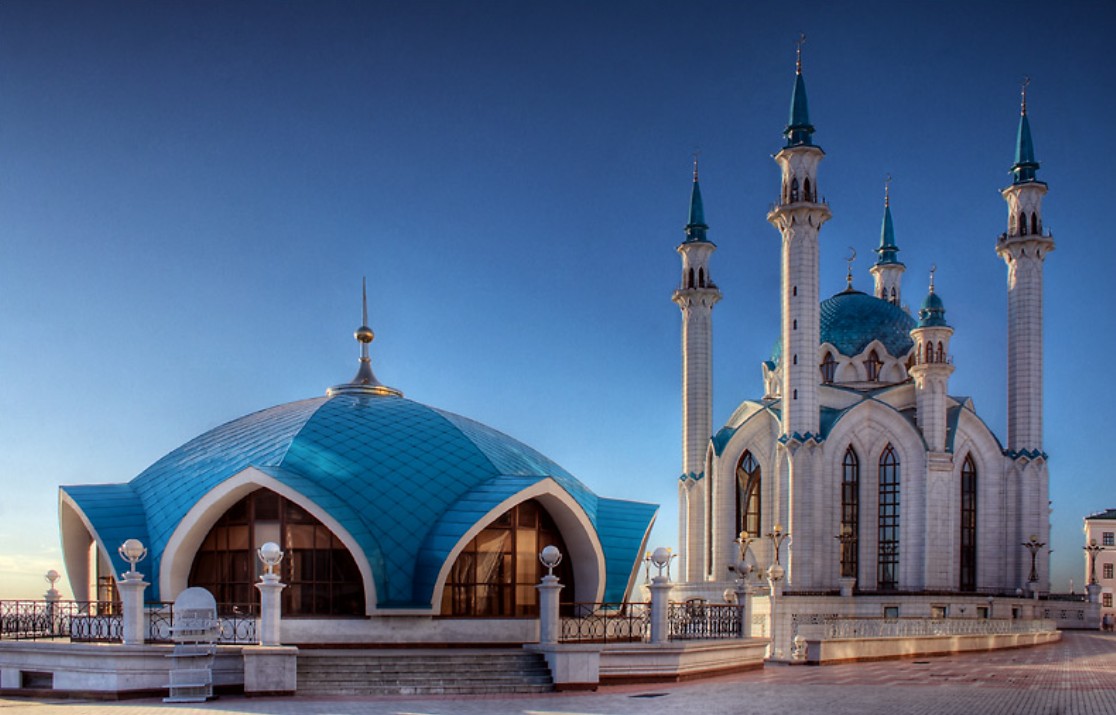
The Kazan Kremlin is the only surviving Tatar fortress in Russia and is described as the northwestern limit of the spread of Islam and the southern extremity of the Pskov‑Novgorod Orthodox architectural tradition. Within its walls stand the Kul Sharif Mosque and the Annunciation Cathedral, whose juxtaposition has become an emblem of religious coexistence in Tatarstan and in Russian state narratives of “traditional” interfaith harmony.
The modern Kul Sharif Mosque, inaugurated in 2005 for the 1000‑year anniversary of Kazan, commemorates an earlier mosque destroyed when Ivan the Terrible’s forces captured Kazan in 1552. Built with support from local donors and Muslim countries, the mosque is now one of the largest in Russia and Europe, and its presence adjacent to the Orthodox cathedral is frequently cited by local leaders and journalists as a symbol of peaceful coexistence between Islam and Christianity in Kazan.
Tatar Muslim heritage as cultural bridge
Beyond its architecture, Kazan is a center of Tatar Muslim intellectual and spiritual life that historically mediated between the Russian state and Muslim communities across the empire. Historical scholarship on Kazan Tatars describes how, from the eighteenth century onward, Kazan’s Muslim scholars and merchants helped shape Russia’s expansion into the South Urals, western Siberia and the Kazakh steppe, positioning themselves as leaders of Islamic modernity within the empire.
This legacy continues in contemporary cultural projects that seek to reassert Tatarstan’s role as a hub of “traditional Islam” in Russia. Tourism initiatives emphasize sites such as the Bolgar Historical and Archaeological Complex, another UNESCO‑listed center of early Islam on the Volga, and promote itineraries like “Moscow + Kazan: Two Capitals of One Horizon” tailored for visitors from Muslim‑majority countries, with halal hotels and medical services.
At the political level, Tatarstan’s leadership plays an active role in Russia’s relationship with the Islamic world. The “Russia – Islamic World: Group of Strategic Vision” meets in Kazan, and the region is presented as a showcase of successful Muslim integration within the Russian Federation, with local elites frequently stressing religious tolerance and multiethnic coexistence.
The 2026 cultural programme
Kazan’s year as Cultural Capital of the Islamic World is being marked by an extensive programme of events developed in partnership with ICESCO and OIC institutions. ICESCO and Tatarstan signed a new cultural cooperation agreement specifically “in celebration of Kazan as 2026 Cultural Capital in the Islamic World,” emphasizing youth and women’s empowerment, innovation, sustainable development and the promotion of Kazan as a platform for cultural creativity.
The agreement frames Kazan’s 2026 status as an opportunity to host “an extensive cultural program and a range of qualitative activities” that highlight youth potential, support creative initiatives and strengthen cultural identity as a source of civilizational development. Tatarstan’s Ministry of Culture and partners have outlined a calendar that includes large‑scale festivals, exhibitions, educational programmes, and forums, often aligned with existing events that already attract participants from the broader Islamic world.
Festivals, arts, and creative industries
The Cultural Capital year amplifies existing cultural festivals that already have a Muslim or intercultural focus, while also launching new projects designed to showcase Tatar and broader Islamic culture. Tatarstan’s cultural authorities have highlighted planned events such as a Modest Fashion Festival, which builds on the global growth of Islamic fashion and positions Kazan as a platform for designers and brands targeting Muslim consumers.
Another flagship is the International Muslim Film Festival, which has been held in Kazan for years and focuses on films that promote humanistic values, religious tolerance, and intercultural dialogue.
Museums and heritage institutions, including the Kazan Kremlin Museum‑Reserve and Islamic history museums in Kazan and Bolgar, are expected to curate special exhibitions on Tatar Islamic heritage, Sufi traditions, calligraphy, and the city’s role in wider Islamic intellectual history. Many of these initiatives are explicitly oriented toward youth audiences, with ICESCO‑backed projects focusing on digital content, storytelling, and capacity‑building for young creatives.
Interfaith dialogue and symbolic spaces
Interfaith coexistence is one of the core narratives underpinning Kazan’s Cultural Capital year. Russian and Tatarstan officials frequently point to the Kul Sharif Mosque and the Annunciation Cathedral standing side by side inside the Kazan Kremlin as the clearest visual symbol of this message.
Commentators note that barely 100 metres separate the two structures, a fact used to illustrate the close, everyday proximity of Islam and Orthodox Christianity in Kazan’s urban landscape. Former Tatarstan President Mintimer Shaimiev described the Kul Sharif and the Cathedral as embodying “aspirations of the multi‑ethnic peoples of the republic to live in peace and friendship,” while journalists and travel writers have framed the Kremlin as a place where “Islam and Christianity go hand in hand.”
Tourism, halal lifestyle and soft power
The Cultural Capital year is also a tourism and soft‑power project. Articles aimed at audiences in Gulf and other Muslim‑majority countries describe Tatarstan as a key driver of a rising tourist flow from Islamic countries to Russia, with Kazan portrayed as a city that has “preserved its rich spiritual traditions and relics” and offers a distinct Russian‑Muslim experience.
From a soft‑power perspective, the initiative allows both Tatarstan and the federal Russian government to send several messages simultaneously: that Russia is home to more than twenty million Muslims and is therefore partly a “Muslim country”; that it seeks closer engagement with OIC states; and that it can offer a narrative of religious coexistence despite geopolitical tensions with Western countries.
Kazan as a Eurasian Islamic hub
Kazan’s designation as Cultural Capital of the Islamic World 2026 crystallizes dynamics that have been developing for years: the revival of Tatar Muslim heritage, the promotion of interfaith coexistence, and the city’s emergence as a convening space for Russia–Islamic world dialogue.
Through a dense calendar of cultural festivals, film and fashion events, youth programmes, heritage exhibitions and economic forums, Kazan is projecting itself as a Eurasian hub where Russian, Tatar and global Islamic cultures intersect. The success of this initiative will be measured not only in visitor numbers or investment deals, but in the extent to which it deepens genuine cultural exchange, supports local creative communities, and sustains a pluralistic space for Islamic culture within the broader fabric of Russian society.
Ahmad Suhaib Siddiqui Nadvi
Global Horizon
Email: al.emam.education@gmail.com
Al-Emam Al-Nadwi Education & Awakening Center
—
References:
- [Kazan to Become a Cultural Capital of the Islamic World Next Year] (https://kazanforum.ru/en/press-center/news/12113/)
- [Kazan Named Cultural Capital of the Islamic World for 2026] (https://russia-islworld.ru/en/rossia/kazan-named-cultural-capital-of-the-islamic-world-for-2026-2025-02-13-47311/)
- [A briefing on “Kazan – the cultural capital of ICESCO in 2026” was held] (https://russia-islworld.ru/en/kultura/a-briefing-on-kazan-the-cultural-capital-of-icesco-in-2026-was-held-2025-02-18-47389/)
- [Kazan hosts first-ever OIC Culture Ministers’ Congress in …] (https://www.aa.com.tr/en/energy/general/kazan-hosts-first-ever-oic-culture-ministers-congress-in-russia/49266)