


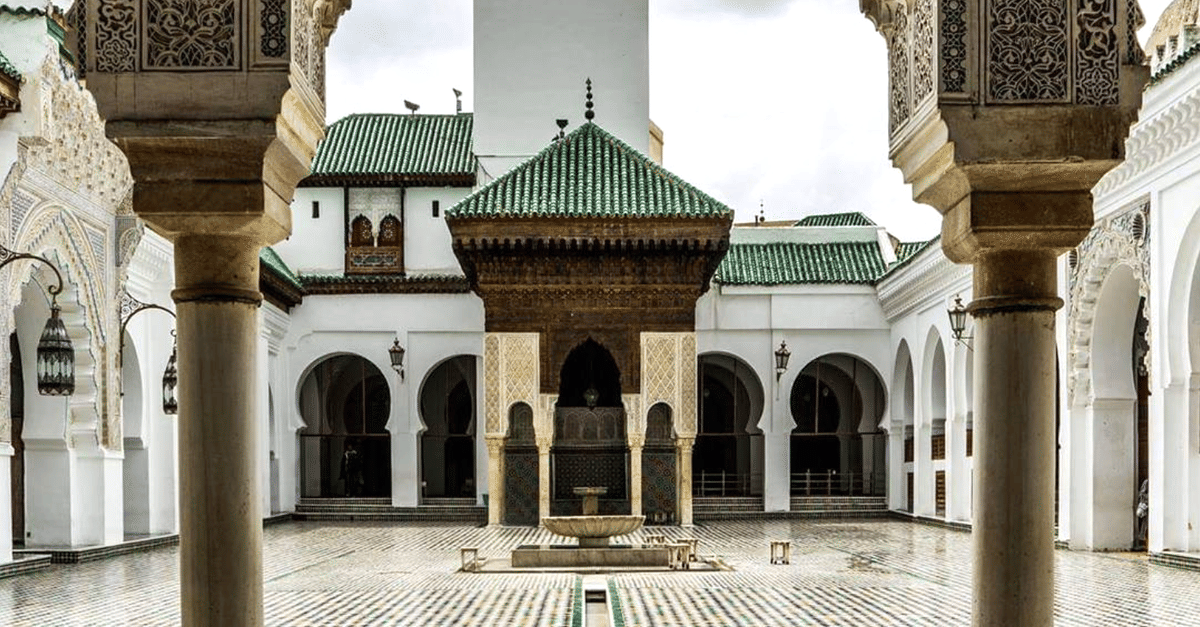
More than 1,100 years ago, in the vibrant city of Fez, Morocco, a woman named Fatima al-Fihri turned grief, wealth, and vision into one of history’s greatest gifts. In a time when women’s names were rarely preserved in public memory, Fatima did something extraordinary: she founded the University of al-Qarawiyyin, widely recognized by UNESCO and Guinness World Records as the world’s oldest continuously operating university. Her story is not only about the birth of an institution; it is about the power of education, philanthropy, and the courage to build something that outlives a lifetime.
Today, as universities around the world compete for prestige and influence, al-Qarawiyyin stands apart for a deeper reason. It is a living monument to the belief that knowledge should be preserved, shared, and renewed across generations. And in a modern world searching for models of women’s leadership, Fatima al-Fihri’s legacy feels not historical, but urgent.
Fatima al-Fihri’s story
Fatima al-Fihri’s story begins with migration, faith, and family fortune. According to historical accounts summarized by sources including World History Encyclopaedia and EBSCO, Fatima and her sister Maryam were born into a wealthy merchant family, likely of Qayrawani origin, before settling in Fez, Morocco. Their father’s death left them with inherited wealth, but instead of using it only for private comfort, Fatima chose a public endowment, or waqf, to build a mosque and learning center that would become al-Qarawiyyin. Maryam, her sister, is also remembered for founding the Al-Andalus Mosque in Fez, another powerful sign that scholarship, architecture, and devotion were not confined to men in the Islamic world of the 9th century.
That fact alone is astonishing. Yet the deeper lesson is even more striking: Fatima did not merely build a structure. She helped create a culture of learning.
A Symbol of The Continuity of Knowledge
The University of al-Qarawiyyin is far more than an old building. It is a symbol of the continuity of knowledge. Wikipedia’s account of the university notes that it began as a mosque in 859 CE and developed over centuries into an influential center of higher learning. It taught religious studies, law, grammar, mathematics, astronomy, medicine, and philosophy, drawing scholars from across the Islamic world and beyond. The site became a bridge between civilizations, a place where manuscripts were copied, debated, preserved, and transmitted.
Its significance is not only age, though that alone is remarkable. The university’s claim to being the world’s oldest operating university is supported in modern references including Guinness-recognized summaries and widely reported features such as the Fox News piece on the “oldest university in the world,” which helped bring public attention to this enduring institution. EBSCO’s research summary likewise presents al-Qarawiyyin as a historic center of learning with a long, continuous institutional life. In an age of short attention spans, al-Qarawiyyin reminds us that wisdom is a long project.
The architecture itself tells a story. Over the centuries, rulers expanded and enriched the complex, adding libraries, prayer halls, courtyards, and scholarly spaces. One of its most famous treasures is the library, restored in recent years, which houses rare manuscripts and reflects Morocco’s wider effort to preserve cultural heritage. The university is not frozen in the past; it continues to live, to teach, and to represent Fez as a city of memory and learning.
An Act of Devotion and Public Benefit
What makes Fatima al-Fihri’s legacy so emotionally powerful is that it speaks to the human need to leave something meaningful behind. She did not establish al-Qarawiyyin for fame. Historical retellings emphasize that the foundation was an act of devotion and public benefit. That matters. In a world often driven by profit and visibility, her example offers a different measure of success: building institutions that serve others long after the builder is gone.
This is where Maryam’s story deepens the message. Together, the two sisters represent more than a historical curiosity. They embody a profound truth: women have always been builders of civilization, even when the record has not always honored them. Fatima’s mosque-university and Maryam’s mosque stand as twin landmarks of female patronage in Fez. Their lives challenge the lazy assumption that women’s contributions to public life are modern inventions. They are not. They are ancient, real, and foundational.
The emotional force of this history is impossible to ignore. Fatima’s legacy is especially moving because it begins in loss. After her father’s death, she and Maryam inherited wealth. But wealth alone never made history. Vision did. Resolve did. Faith did. Fatima looked at what she had and asked what it could become for others. That question still echoes today: What are we building with what we’ve been given?
The Revival of Fatima’s Legacy
The modern revival of Fatima’s legacy is happening on several fronts. First, Morocco has made significant efforts to restore and celebrate al-Qarawiyyin as both a university and a heritage site. The restoration of the library, the protection of the manuscripts, and the architectural conservation of the complex all reflect a national effort to safeguard memory. These efforts matter because cultural heritage is fragile; without care, even great civilizations forget themselves.
Second, Fatima’s story is being revived in global conversations about women’s leadership, Islamic intellectual history, and the origins of the university itself. For many readers, the idea that the world’s oldest operating university was founded by a woman is surprising. That surprise is itself revealing. It shows how often history has been narrowed by incomplete storytelling. Today, educators, writers, and institutions are correcting that record, and in doing so, they are giving Fatima the place she deserves.
Third, her legacy offers a practical lesson for personal growth and civic life. Fatima reminds us that enduring impact is rarely flashy. It is built through service, structure, and patience. Whether one is founding a school, supporting a scholarship fund, preserving manuscripts, mentoring young people, or simply choosing generosity over self-interest, the spirit of al-Fihri is alive whenever learning is treated as a public good.
And that is perhaps the most inspiring part of her story: Fatima’s legacy is not locked in the past. It is reproducible. It can be revived wherever people choose to invest in knowledge, institutions, and future generations.
Ideas Can Outlast Empires
Fatima al-Fihri did not set out to become a legend. She set out to do something useful, sacred, and lasting. Yet history has made her into something larger: a symbol of how one woman’s vision can shape the intellectual life of the world. The University of al-Qarawiyyin, still operating after more than a millennium, is not just the oldest of its kind. It is a living answer to the question of whether ideas can outlast empires. They can. And so can the courage behind them.
In Fatima’s story, we see more than the founding of a university. We see the power of education as legacy, the strength of women as world-builders, and the possibility that a single act of generosity can echo through centuries. As Morocco and the wider world continue efforts to preserve al-Qarawiyyin and honor its founder, Fatima al-Fihri’s message remains wonderfully clear: build for others, build for knowledge, and build as if the future depends on it.
Because in the end, it does.
Ahmad Suhaib Siddiqui Nadvi
Global Horizon
Email: al.emam.education@gmail.com